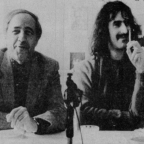
Libération - gennaio 1984
Materiale attinente:
|
|
Materiale attinente: |
| English Español Français | Italiano Español Français |
Intervista di Philippe Olivier e Patrice Bollon | Interview by Philippe Olivier and Patrice Bollon |
|
| Zappa-Boulez, stessa lotta? | Zappa-Boulez, same fight? |
| Traduzione dal francese | Reverse translation from French |
| Una folla immensa stasera al Théâtre de la Ville, dove Pierre Boulez ha diretto tre opere di Frank Zappa “alla presenza del compositore”, che ci ha concesso un’intervista esclusiva. Un percorso fra la sua gratitudine verso alcuni compositori del XX secolo, il suo senso dell’umorismo molto anglosassone e il suo costante desiderio di riconoscimento: “Compongo musica seria da quando avevo 14 anni”… | A huge crowd gathered tonight at the Théâtre de la Ville, where Pierre Boulez will conduct three works by Frank Zappa “in the presence of the composer”, who gave us an exclusive interview. A journey through his appreciation for certain 20th century composers, his very Anglo-Saxon sense of humor, and his constant desire for recognition: “I’ve been composing serious music since I was 14”… |
| Zappa/Boulez: per la maggior parte dei critici francesi l’incontro tra la rockstar californiana, figura di spicco del rock progressivo degli anni ’60, e il carismatico compositore e direttore d’orchestra è stato una sorpresa, quasi uno scandalo. Non appena ne è stato dato l’annuncio, l’Ensemble intercontemporain è stato inondato di telefonate. La gente voleva vedere le partiture. Dubitava persino della loro esistenza. Si interrogava sulle motivazioni di Zappa - desiderio di riconoscimento o di pubblicità? - e su quelle di Boulez… | Zappa/Boulez: For most French critics, the meeting between the Californian rock star, a leading figure in 60s progressive rock, and the charismatic composer and conductor has been a surprise, almost a scandal. As soon as the announcement was made, the Ensemble intercontemporain was inundated with phone calls. People wanted to see the scores. They even doubted their existence. They wondered about Zappa’s motivations - a desire for recognition or publicity? - and those of Boulez… |
| Questi atteggiamenti derivano principalmente da ignoranza. Non è la prima volta che la musica di Zappa viene eseguita da un ensemble “serio”. L’illustre musicista baffuto si era già fatto accompagnare dalla Royal Philharmonic Orchestra nel suo film-opera “200 Motel”. Dove aveva persino citato il Wozzeck di Berg! L’anno scorso il direttore della Los Angeles Philharmonic, Zubin Mehta, ha incluso alcune delle sue opere nel proprio programma “Musica del XX secolo”. Infine, è appena uscito un primo volume delle opere sinfoniche di Zappa, eseguite dalla London Symphony Orchestra. | These attitudes stem primarily from ignorance. This isn’t the first time Zappa’s music has been performed by a “serious” ensemble. The distinguished, mustachioed musician had already been accompanied by the Royal Philharmonic Orchestra in his film-opera “200 Motels”. There he even quoted Berg’s Wozzeck! Last year, Los Angeles Philharmonic conductor Zubin Mehta included some of his works in his “Music of the 20th Century” program. Finally, a first volume of Zappa’s symphonic works, performed by the London Symphony Orchestra, has just been released. |
| C’è anche un segreto sdegno in questa incomprensione della critica. In Francia, la gente non capisce ancora che si può amare sia la musica classica sia il rock. | There’s also a secret disdain in this lack of understanding by the critique. In France, people still don’t understand that one can love both classical music and rock. |
| Chi si considera colto non può immaginare che possa esistere anche un’altra forma di cultura. E viceversa. I mondi della cosiddetta musica “seria” e del rock non si incontrano mai, secondo le leggi di un cartesianesimo riduttivo. Non è così negli Stati Uniti, dove Terry Riley ha potuto suonare con John Cale. Philip Glass non è forse anche lui molto vicino alle sperimentazioni del rock? | Those who consider themselves cultured can’t imagine that another form of culture could exist. And vice versa. The worlds of so-called “serious” music and rock never intersect, according to the laws of a reductive Cartesianism. This isn’t the case in the United States, where Terry Riley could play with John Cale. Likewise, isn’t Philip Glass very close to rock experimentation? |
| Chi critica questi incontri dovrebbe comunque essere rassicurato dal concerto di stasera. Perché, in sostanza, non c’è nessuno più classico e più saggio di Zappa quando compone per un’orchestra tradizionale. Un tocco di Stravinsky, di Berg e di Varèse, mescolati in salsa neoclassica: non c’è nulla che possa spaventare il melomane medio. Di Varèse, la sua influenza predominante, Zappa ha conservato solo la forma, non lo spirito. Varèse voleva che la musica fosse un’arte crudele, che sconvolgesse gli ascoltatori, li spogliasse del loro conformismo e li immergesse in un mondo tragico e primitivo dominato dalla passione e dall’impulso. E questa potrebbe essere la migliore definizione di musica drammatica: che si tratti di opera o di rock. | Those who criticize these meetings should be reassured by tonight’s concert. Because, essentially, there’s no one more classical and wiser than Zappa when he composes for a traditional orchestra. A hint of Stravinsky, Berg and Varèse, mixed by a neoclassic sauce: there’s nothing to scare the average music lover. Of Varèse, his predominant influence, Zappa retained only the form, not the spirit. Varèse wanted music to be a cruel art, shocking the listeners, stripping them of their conformism and immersing them in a tragic and primitive world dominated by passion and impulse. And this might be the best definition of dramatic music: whether it’s opera or rock. |
| Si può affermare che Zappa sia ben lontano da quest’obiettivo. La sua musica è un buon esercizio di stile, seppure un po’ inespressivo. Si basa sulla trasposizione del suo universo, già accademico in fatto di rock, nei codici della composizione classica. Un montaggio abile e professionale di influenze provenienti da una vasta gamma di fonti. Un’estetica neo-dadaista del collage a cui manca ciò che Varèse auspicava e che costituisce anche l’essenza del rock autentico: la potenza del gesto. E la sua evidenza. | It’s fair to say that Zappa is far from the mark. His music is a good stylistic exercise, though a little inexpressive. It’s based on the transposition of his universe, already academic in the field of rock, into the codes of classical composition. A skillful and professional montage of influences from a wide range of sources. A neo-Dadaist aesthetic of collage that lacks what Varèse advocated and that also constitutes the essence of authentic rock: the power of gesture. And its evidence. |
| Zappa: “La reputazione di Boulez si è sempre basata sulla precisione ritmica” | Zappa: “Boulez’s reputation has always been based on rhythmic precision” |
| Come è nata l’idea di collaborare con Boulez? | How did the idea of collaborating with Boulez come out to you? |
| Ci sono voluti tre o quattro anni. Dapprima ho inviato a Pierre Boulez alcune partiture per grande orchestra e gli ho chiesto se potesse dirigerle. Mi ha risposto che non poteva eseguire quelle opere con l’Ensemble intercontemporain e mi ha chiesto di scrivere qualcosa per un ensemble più piccolo. È quello che ho fatto con “Il perfetto sconosciuto”. | It took three or four years. First, I sent Pierre Boulez some scores for large orchestra and asked him if he could conduct them. He replied that he couldn’t perform those works with the Ensemble intercontemporain and asked me to write something for a smaller ensemble. That’s what I did with “The Perfect Stranger”. |
| Perché ci tenevi tanto che Pierre Boulez dirigesse le tue opere? | Why were you so keen to have Pierre Boulez conducting your works? |
| Soprattutto per la sua reputazione nella precisione ritmica. Sotto questo aspetto, i miei pezzi presentano alcune difficoltà. Nella musica moderna il problema principale è trovare esecutori in grado di interpretare correttamente ritmi complessi. La reputazione di Boulez si è sempre basata su questa attenzione, è stata quindi una scelta naturale. | Mainly because of his reputation for rhythmic precision. In this regard, my pieces present some difficulties. In modern music, the biggest problem is finding performers capable of correctly interpreting complex rhythms. Boulez’s reputation has always been based on this concern, so this was a natural choice. |
| Hai parlato di precisione. Provi nostalgia per quella precisione, apparentemente prerogativa dei musicisti classici? | You mentioned precision. Do you feel nostalgic for that precision, seemingly the prerogative of classical musicians? |
| No. Pochi sanno che prima di suonare rock scrivevo musica da camera dall’età di 14 anni. Mi sono avvicinato al rock solo a 21 anni. La mia passione iniziale era la musica contemporanea. Ma nessuno voleva suonare i miei spartiti. Negli Stati Uniti è molto difficile far suonare la propria musica. Ho dovuto dedicarmi al rock semplicemente per poter far ascoltare la mia musica. Eppure scrivo fin dall’adolescenza, e molti dei miei pezzi non sono mai stati eseguiti. Quindi quest’attività è tutt’altro che un hobby. | No. Few people know that before playing rock, I’d been writing chamber music since I was 14. I only got into rock when I was 21. My initial passion was contemporary music. But no one wanted to play my scores. In the United States, it’s very difficult to get your music played. I had to devote myself to rock simply to be able to get my music heard. Yet I’ve been writing since I was a teenager, and many of my pieces have never been performed. So, this activity is anything but a hobby. |
| Si dice che uno dei primi dischi che hai comprato fosse di Varèse. Che influenza ha avuto su di te? | It’s said that one of the first records you bought was by Varèse. What influence did he have on you? |
| Avevo letto una recensione sarcastica di quell’album su una rivista americana, Look Magazine. L’articolo parlava della catena di negozi Sam Goody a New York e diceva: “Sam Goody è un venditore così bravo che riesce persino a vendere questo album”. Sono uscito subito per comprarlo e mi è piaciuto molto. | I read a sarcastic review of that album in an American magazine, Look Magazine. The article talked about the Sam Goody chain of stores in New York and said: “Sam Goody is such a good salesman, he even manages to sell this album”. I immediately went out to buy it and loved it. |
| Di che album si trattava? | What album was it? |
| Si intitolava “Le Opere Complete di Edgard Varèse, Volume 1”, e fu registrato nel 1950. Includeva ♫ “Ionizzazione”, ♫ “Densità 21,5”, ♫ “Octandre” e ♫ “Integrali”. | It was titled “The Complete Works of Edgard Varèse, Volume 1”, and was recorded in 1950. It included ♫ “Ionisation”, ♫ “Density 21.5”, ♫ “Octandre”, and ♫ “Intégrales”. |
| Quali altri compositori del XX secolo ammiri? | What other 20th century composers do you admire? |
| Oltre a Varèse, mi piacciono Webern, Stravinsky, Takemitsu e alcune opere di Penderecki, come ♫ “De natura sonoris” o l’opera ♫ “I Diavoli di Loudun”. Apprezzo molto anche Kagel. | Besides Varèse, I like Webern, Stravinsky, Takemitsu, and some of Penderecki’s works, like ♫ “De Natura Sonoris” or the opera ♫ “The Devils of Loudun”. I also really appreciate Kagel. |
| La sua concezione del teatro musicale non è, in sostanza, molto lontana dal rock… | His conception of musical theater isn’t, essentially, far removed from rock… |
| Però è migliore, molto migliore. | Except that it’s better, much better. |
| Potresti lavorare con lui! (risata). Gli piacciono le messe in scena, gli effetti di fumo e i cerimoniali. | You could work with him! (laughter). He likes staging, smoke effects and ceremonies. |
| Forse. In ogni caso, ha la mia stima. | Maybe. In any case, he has my respect. |
| Pensi che, da questa prospettiva, la musica contemporanea trarrebbe beneficio dall’ispirarsi al rock? | Do you think, from this perspective, that contemporary music would benefit from taking inspiration from rock? |
| Usando degli effetti di fumo, intendi? | Using smoke effects, you mean? |
| Pierre Henry e Kagel lo hanno fatto ne “Il Tradimento Orale”. | Pierre Henry and Kagel did this in “The Oral Betrayal”. |
| Si raggiungerebbe allora un pubblico che viene per gli effetti di fumo, non per la musica. | You’d then reach an audience that comes for the smoke effects, not for the music. |
| Che cosa speri di ottenere dalla collaborazione con dei musicisti classici? | What do you hope to gain from collaborating with classical musicians? |
| Se c’è un’attività umana che comporta inevitabilmente una perdita finanziaria, è la musica contemporanea… (risata). | If there’s one human activity that inevitably results in financial loss, it’s contemporary music… (laughter). |
| Intendevamo un beneficio musicale o intellettuale… | We meant a musical or intellectual benefit… |
| Non la vedo in questi termini. Se qualcuno dedica del tempo a scrivere musica, questa deve essere eseguita, ed eseguita bene. Il mio unico interesse in questo caso particolare è che l’esecuzione sia buona. Probabilmente non potrebbe essere migliore di quella di Boulez e dell’Ensemble intercontemporain. | I don’t see it that way. If someone dedicates time to writing music, it should be performed, and performed well. My only interest in this particular case is that the performance is good. It probably couldn’t be better than that of Boulez and the Ensemble intercontemporain. |
| Se ti offrissero l’opportunità di lavorare all’IRCAM con il computer 4X, accetteresti? | If you were offered the opportunity to work at IRCAM with the 4X computer, would you accept? |
| Ho già un computer a casa, grazie… (risata). Negli ultimi sei mesi ho lavorato a un concerto per pianoforte con l’aiuto di questo computer e spero che venga eseguito presto. | I already have a computer at home, thank you… (laughter). For the past six months, I’ve been working on a piano concerto with the help of this computer, and I hope it will be performed soon. |
| A che cosa ti serve il computer? Per trasformare i suoni? | What do you use a computer for? To transform sounds? |
| No. In realtà il suono proveniente da un computer è molto simile a quello di un pianoforte Fender Rhodes. Sono interessato ai computer perché mi permettono di inventare ritmi e realizzare esecuzioni che nessuna mano umana potrebbe realizzare, e a una velocità molto elevata. Con un computer posso far suonare la musica che programmo in un modo che sarebbe impossibile per una singola persona. | No. Actually, the sound coming from a computer is very similar to that of a Fender Rhodes piano. I’m interested in computers because they allow me to invent rhythms and achieve performances that no human hand could achieve, and at very high speed. With a computer, I can make the music I program sound in a way that would be impossible for a single person. |
| Oltre al tuo concerto per pianoforte, hai dei lavori in corso? | Besides your piano concerto, do you have other works in progress? |
| Sì. Un brano per pianoforte solo e alcuni brani che non hanno ancora un titolo. Ho assegnato loro dei numeri: il numero 43 è un brano per archi e chitarra elettrica suonato però interamente dal computer, che produce un suono molto buono a partire dalla chitarra elettrica. | Yes. A piece for solo piano and some pieces that don’t yet have titles. I’ve assigned numbers to them: number 43 is a piece for strings and electric guitar, but played entirely by the computer, which produces a very good sound out of the electric guitar. |
| Significa che stai abbandonando il rock? | Does this mean you’re abandoning rock? |
| Assolutamente no. Il mio prossimo album uscirà tra sei settimane. | Absolutely not. My next album is out in six weeks. |
| Che distinzione fai tra rock e musica “seria”? | What distinction do you make between rock and “serious” music? |
| La stessa che tra pittura e scultura, guidare un’auto o mangiare un panino… Una persona può fare tutte queste cose. Perché dovrebbe limitarsi a una sola attività? | The same as between painting and sculpting, driving a car or eating a sandwich… Persons can do all these things. Why should they limit themselves to just one activity? |
| Stai cercando di avvicinare i due generi, di fonderli? | Are you trying to bring the two genres closer together, to merge them? |
| Non proprio. Se pensi solo alla composizione, alla struttura dei vari elementi, la vicinanza è ovvia. È essenzialmente la stessa attività, che io componga un pezzo rock & roll o musica da camera. Ma il suono risultante sarà diverso. | Not really. If you just think about composition, about the structure of the various elements, the similarity is obvious. It’s essentially the same activity, whether I write a rock & roll piece or chamber music. But the resulting sound will be different. |
| Come vedi la musica in futuro? | How do you see music in the future? |
| Sarà noiosissima. | It will be very boring. |
| Perché? | Why? |
| La musica e il suo sistema di distribuzione sono controllati da persone noiose. Non credo che i musicisti in sé siano insopportabili. Ma le concessioni che devono fare al sistema per poter essere registrati e distribuiti hanno ridotto la qualità, l’intensità e persino il contenuto della musica al punto da ridurla a un mero prodotto. Forse, adesso più che mai, quelli che decidono i contratti di registrazione e la distribuzione stanno svilendo la musica. | Music and its distribution system are controlled by boring people. I don’t think musicians themselves are unbearable. But the concessions they have to make to the system to be recorded and distributed have reduced the quality, intensity and even content of music to the point of reducing it to nothing more than a product. Perhaps, now more than ever, those who decide recording contracts and distribution are debasing music. |
| Essere una “rockstar” ti ha aiutato a essere suonato da formazioni “serie”? | Has being a “rock star” helped you get played by “serious” bands? |
| Di certo non mi ha danneggiato. Mi chiedo se questo concerto diretto da Boulez si sarebbe mai tenuto se io fossi stato un perfetto sconosciuto. In questo caso, lui avrebbe letto i miei spartiti? D’altra parte, essendo io una rockstar, alcuni verranno al concerto per giudicare la mia musica secondo gli standard del rock & roll o da un punto di vista “prospettivo”. Non credo che ciò sia necessario, né mi lusinga. | It certainly hasn’t disadvantaged me. I wonder if this concert conducted by Boulez would ever have taken place if I had been completely unknown. In that case, would he have read my scores? On the other hand, since I’m a rock star, some people will come to the concert to judge my music by rock & roll standards or from a “perspective” point of view. I don’t think it’s necessary, nor does it flatter me. |
| Quali musicisti ti piacciono nel mondo del rock? | Which musicians do you like in the rock world? |
| Mi piace Allan Holdsworth. | I like Allan Holdsworth. |
| Chi è? | Who is he? |
| Allan Holdsworth, un ottimo chitarrista inglese. Mi piacciono anche i Tom Tom Club. E poi… (lungo silenzio). | Allan Holdsworth, a great English guitarist. I also like the Tom Tom Club. And then… (long silence). |
| Non molti altri, in realtà… | Not many others, actually… |
| Sì. Pochissimi. | Yes. Very few. |
| Puoi parlarci dei brani che verranno eseguiti il 9 gennaio dall’Ensemble intercontemporain? | Can you tell us about the pieces that the Ensemble intercontemporain will perform on January 9th? |
| Un brano è stato commissionato dall’Ensemble intercontemporain e si intitola “Il perfetto sconosciuto”. Inizia con una terza maggiore, come il suono di un campanello. Quando lo ascolti, pensa a un venditore porta a porta che cerca di vendere un aspirapolvere a una casalinga. Gli altri due brani si intitolano “Aviazione navale in arte?” e “Il paradiso di Fifi Dupree”. Il primo è molto breve e ricorda un corale. Il secondo riprende un tema delle Mothers of Invention, quando Ian Underwood e George Duke ne facevano parte. L’intero set dura circa venti minuti. | One piece was commissioned by the Ensemble intercontemporain and is called “The Perfect Stranger”. It begins with a major third, like the sound of a doorbell. When you listen to it, think of a door-to-door salesman trying to sell a vacuum cleaner to a housewife. The other two pieces are called “Naval aviation in art?” and “Dupree’s paradise”. The first is very short and reminiscent of a chorale. The second takes up a theme from the Mothers of Invention, when Ian Underwood and George Duke were in the band. The entire set lasts about twenty minutes. |
| Che effetto fa essere inclusi insieme a Carter, Ives e Ruggles in un programma di musica americana? | How does it feel to be included with Carter, Ives, and Ruggles on a program of American music? |
| (perplesso) | (perplexed) |
| Che cos’hai in comune con loro? | What do you have in common with them? |
| La nazionalità e basta! (risata). | Nationality, that’s all! (laughter). |
| Boulez: “Non posso ancora svelare le qualità della musica di Zappa” | Boulez: “I can’t yet reveal the qualities of Zappa’s music” |
| Perché questa inaspettata collaborazione con Frank Zappa? | Why this unexpected collaboration with Frank Zappa? |
| M’interessa l’intrusione di uno stile strumentale diverso e di pratiche musicali diverse, situate al di fuori del dominio “classico”. Trovo affascinante incastrare fra di loro queste pratiche. Ma la condizione che pongo per questo tipo di collaborazione è che i partner coinvolti siano dei professionisti. Non mi interessano gli incontri all’insegna di un vago ecumenismo. | I’m interested in the intrusion of a different instrumental style and musical practices, situated outside the “classical” domain. Nesting these practices seems quite fascinating to me. But the condition I set for this type of collaboration is that the partners involved be professionals. I’m not interested in meetings marked by vague ecumenism. |
| Frank Zappa non è l’unico compositore presente nel tuo programma di concerti. Qual è stata la ragione di questa decisione? | Frank Zappa isn’t the only composer featured in your concert program. What was the reason for this decision? |
| Sarebbe stato troppo ingenuo eseguire solo le sue opere. Mi è sembrato più sensato affiancare Frank ad altri musicisti americani, come Charles Ives ed Elliot Carter. Quest’ultimo è la perfetta esacerbazione del mondo della musica come viene vissuto all’interno di una disciplina accademica regolare, derivante dall’insegnamento tradizionale nei conservatori. È quindi un anti-Zappa… | It would have been too naive to perform only his works. It seemed more sensible to me to pair Frank with other American musicians, such as Charles Ives and Elliot Carter. The latter perfectly exacerbates the world of music as it is experienced within a regular academic discipline, derived from traditional teaching in conservatories. He’s therefore an anti-Zappa… |
| E Carl Ruggles, il quarto musicista di questo programma? | And Carl Ruggles, the fourth musician on this program? |
| È molto poco conosciuto in Francia, e mi chiedo se la sua musica sia mai stata eseguita qui. Ruggles appartiene al grande movimento d’avanguardia americano degli anni ‘20, che fu spazzato via dalla depressione economica del 1929. Pochi anni dopo l’evoluzione della musica e delle altre arti negli Stati Uniti iniziò a seguire, in modo molto parallelo, il realismo socialista sovietico, il che è davvero curioso: nacquero contemporaneamente. Derivarono entrambi da un unico fenomeno di recessione economica. Mi è sembrato interessante collegare in un unico programma queste esperienze con quelle odierne. | He’s very little known in France, and I wonder if his music has ever been performed here. Ruggles belongs to the great American avant-garde movement of the 20s, which was swept away by the economic depression of 1929. A few years later, the evolution of music and other arts in the United States began to closely follow Soviet socialist realism, which is really curious: they were born simultaneously. They both arose from a single phenomenon of economic recession. I thought it interesting to connect these experiences with those of today in a single program. |
| Non sarà che la presenza di Zappa è un espediente? | Could it be that Zappa’s presence is a gimmick? |
| Assolutamente no. Le sue opere fanno parte di un programma. Le prendo molto sul serio. | Absolutely not. His works are part of a program. I take them very seriously. |
| Quali qualità musicali ci trovi? | What musical qualities do you find in them? |
| Finché non verranno eseguite nel concerto del 9 gennaio, non posso svelarne le qualità. La sorpresa all’ascolto non deve essere predeterminata… | Until they’re performed at the concert on January 9th, I can’t reveal their qualities. The surprise to be experienced when listening shall not be predetermined… |
Testo originale dal sito Zappa Books. |